Inside the high-stakes realm of today's professional drifting, victory is far more than purely a function of raw horsepower or pilot courage. Conversely, it is now a multifaceted science that demands a meticulous fusion of choosing a inherently capable vehicle platform, outfitting it with the most precise competition hardware, and, most essentially, grasping its live characteristics on the course through cutting-edge drift telemetry software. This exhaustive manual will serve as your master plan from the very first idea of a project car right through to the last data-informed adjustments that transform a strong car into a repeatable podium finisher. We will thoroughly explore the methodical process of vehicle alignment optimization, illustrating how a state-of-the-art suspension tuning tool like precise measurement hardware removes guesswork and provides unparalleled clarity into your car's actual performance.
The bedrock of any exceptional drift machine is, without question, the base vehicle itself. Several vehicles have earned legendary standing within the international oversteer scene due to their inherent handling characteristics, strong construction, and the enormous range of aftermarket parts available. Selecting the optimal car is the first and most significant decision a driver will make. As an example, the the E36 generation BMW is universally acknowledged as one of the greatest all-around cars for drifting of the modern era. Its almost ideal 50/50 weight distribution, combined with a rear-wheel-drive configuration and bulletproof straight-six engines, establishes a car that is simultaneously easy to handle for beginners and incredibly capable in the control of a expert driver. The next step of this lineage, the E46 model BMW, refines these strengths with a increasingly sophisticated frame, wider wheel track for greater stability, and still increased steering angle directly from the OEM. Another powerful option in the top-level arena is the C6 generation Corvette.
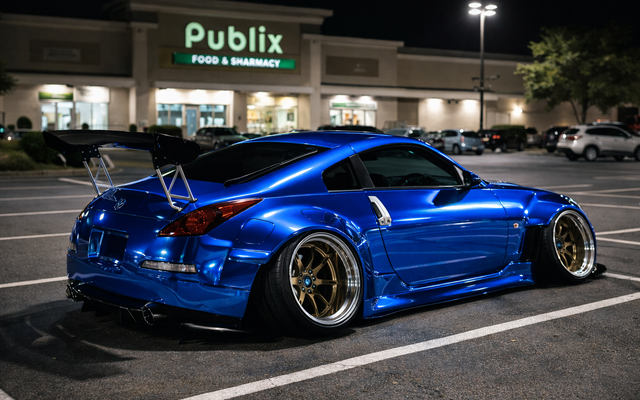
This muscle-derived sports car introduces a distinctive combination of strengths to the drifting discipline, such as a lightweight aluminium structure, a backwards-positioned transaxle that aids in an ideal front-to-rear mass ratio, and the colossal torque of a large-displacement LS V8 motor. This blend transforms it into an complete force on track, capable of initiating and maintaining long drifts with apparently easy use of power. For builders seeking exceptional value, the Nissan 350Z stands out as a prime example. It arrives from the factory with a stiff platform, a decent original locking differential, and the responsive V6 motor that offers sufficient horsepower and torque for mastering and progressing in the sport. Its successor, the Nissan Z34, brings further refinements in structural rigidity, suspension design, and overall engine output, establishing its status as a common selection among serious competitors. Further historic cars that deserve mention are the nimble Wankel-engined Mazda FC RX-7, the most popular Nissan S13, the torque-rich Ford Mustang SN95, the electronic-equipped BMW E90, and the tiny yet incredibly fun and teachable Mazda MX-5. Every single one of these platforms gives a unique array of characteristics, complexities, and capabilities, but they all share the basic elements necessary to become a serious sliding vehicle.
However, choosing the right car is merely the starting point. To release the true capability of any of these machines, significant modifications to the steering and suspension systems are completely essential. This is where the realm of precision tuning hardware enters sharp importance. The single most game-changing modification for a purpose-built drift car is the integration of a maximum-angle drift angle kit. These engineered systems, like those developed by specialist companies like SLR, are engineered to significantly expand the car's possible turning lock. A OEM street car is highly constrained in how far its steering tires can pivot, a safety compromise for public road use. In sliding, however, extreme steering input is continuously needed to control and sustain a angle. An angle kit substitutes the OEM hubs, linkages, and potentially suspension arms with pieces that allow the steered wheels to reach angles over 70 or even 80 degs, compared to a normal OEM setting of around 40 to 50 degrees.
This tremendously increased steering angle offers the operator with exponentially greater command during a slide, enabling it to be far more straightforward to initiate a slide, maintain it through a extended turn, and switch seamlessly from one side to the opposite. The difference in controllability is truly revolutionary. Paired with a correctly specified modification is the equally vital enhancement to the vehicle's suspension. Off-the-shelf or even high-end street dampers are generally not engineered for the specific and harsh demands of drifting. A drift-spec system of suspension units is crucial. These specific coilovers feature unique piston tuning and spring rates that are optimized for the violent weight transfer that is characteristic of aggressive driving. When a pilot starts a slide, the vehicle's mass is shifted violently to the outer of the corner. Proper performance suspension handle this movement in a consistent manner, enabling the car to settle quickly and offering the driver clear feedback through the controls and seat. They also enable accurate setting of stance, rebound and compression stiffness, and cross-weight, which are all fundamental parts of optimizing the car's handling to a particular venue or piloting technique. Together, a top-tier steering angle kit and a properly selected system of performance suspension units constitute the absolute mechanical cornerstone upon which all future optimization is based.
Once the fundamental hardware is in place, the next vital phase in the development is the precise tuning of the car's wheel angles. This is the world of car suspension tuning, a methodology that can feel intimidating to the uninitiated but is, in reality, the key to converting a assembly of capable pieces into a harmonious and consistent whole. The most discussed parameter of suspension geometry for oversteer is undoubtedly camber angle. Wheel camber is the inclination of the wheel in relation to the upright line when looked at from the forward of the vehicle. If the top edge of the tire is tilted towards the chassis, this is called negative camber. For sliding, inward-leaning wheels on the steering tires is universally employed and is considered necessary. The logic is intrinsically tied to vehicle dynamics.
When a chassis is going around a bend at limit angles, the body rolls toward the outside of the bend. This chassis roll forces the outer steering tire to reduce its ideal footprint with the track surface. By adding an inward tilt, the tire is pre-angled to compensate for this roll. As the car leans into the corner, the outside front tire gains a better contact patch with the asphalt, optimizing its bite at the exact time when it is needed most for control. Typically, front axle angles for a serious drift car vary from approximately -3 degrees to as extreme as -5 degrees or even more, contingent on the details of the car configuration, rubber selection, and driver feel. The back wheels also utilize negative camber, but the settings are usually more modest and subtler than the front axle. Too much negative camber at the back can result in the chassis excessively loose and hard to manage on power input, as it diminishes the effective grip area of the driven tires during straight-line acceleration. Hence, rear adjustments are frequently in the range of -1 degree to -3 degrees, finding a delicate equilibrium between offering adequate side grip to assist in initiating and maintaining the drift while simultaneously preserving usable traction for exiting the corner. alignment is just one component of the larger tuning picture, which additionally encompasses toe, self-centering steering, and steer correction modification.
Toe angle refers to the orientation of the wheels as seen from above. Inward toe means the leading edges of the wheels are closer together than the trailing edges, while toe-out means the reverse. For oversteer, a small amount of front toe out is commonly used to quicken the initial response steering reaction, making the chassis feel more responsive and eager to begin a slide. Rear axle toe setting is generally set to zero or a extremely minute amount of toe-in to encourage straight-line stability under acceleration. caster angle is the frontwards or aft tilt of the steering axis when looked at from the lateral of the chassis. Positive caster improves feedback and stability solidity, and it also increases inward lean increase during steering, which is highly advantageous. Tuning these settings is a detailed interplay where a change to one parameter can and often will influence the other settings. The old-school process for setting a car's alignment for competition has long been a time-consuming endeavor of guesswork and adjustment. A tuner or crew would apply a modification based on a hunch, drive the vehicle on track, depend on the operator's subjective sensation and comments, and then apply an additional tweak. This cycle would repeat again and again until the vehicle felt "right" or the available practice time ran out. This methodology is not only exceptionally slow in terms of hours and tires, fuel, and parts, but it is additionally inherently imprecise.
Human sensation is a famously inconsistent data source, influenced by countless factors such as exhaustion, varying track conditions, temperature, and simply the focus of the operator on that specific session. What feels "loose" on one pass drift suspension tuning guide might feel "understeery" on the next pass, leading to contradictory feedback and counterproductive changes. This long-standing limitation in chassis setup is specifically where state-of-the-art engineering tools has made its mark to completely change the landscape.
The rise and application of advanced drift telemetry software has brought about a radically different era for engineering and perfecting competitive sliding vehicles. This new generation of platforms, represented by cutting-edge systems like GripDial, function by physically capturing the real-time dynamic behavior of the vehicle as it is piloted on the circuit. Unlike using personal feedback, these tools acquire quantifiable data on critical variables such as suspension travel, individual tire rotation, acceleration forces, lock position, and accelerator and brake pedal application. This acquired information flow is then analyzed by powerful algorithms that can graph and decode the information in a actionable manner. For the first time ever, tuners and crews can visualize specifically what the car is performing at each point of a drift. This ability changes the complete suspension tuning procedure. Think about the aforementioned goal of dialing in the front camber for a specific chassis. As an alternative to making a change from -3 degrees to -3.5 degrees and then running many laps to try and "sense" a improvement, a suspension tuning tool can deliver immediate and irrefutable feedback. The tool can show graphically how the wheel's loading is performing during the critical moments of a drift: initiation, sustain, and switch. It can show if the existing angle is enabling the steering tire to keep maximum contact or if the tire is overloaded on its outer edge.
The software can after analysis suggest fact-based suggestions for change. Perhaps the information indicates that the tire is still overloading its sidewall at -3.5 degrees of negative camber, indicating that an increase to inward lean, say -4 degrees, might be beneficial. Conversely, the information might indicate that the tire is not achieving temperature or that the inner edge is wearing excessively, which could suggest that there is overly aggressive inward lean and a slight reduction back to -3.2 degrees would be more ideal. This level of granularity and useful intelligence was simply impossible in the days of pure seat-of-the-pants setup.
The impact of utilizing a dedicated suspension tuning tool extends much further than just coilover setup tips optimizing alignment. It becomes an essential suspension tuning guide that is tailored to your particular vehicle. When setting the rebound and compression settings on your suspension, instead of using vague guidelines or copying another car's setup, you can employ the telemetry to observe how the chassis is reacting in response to your changes. The software can display the wheel movement path over a section of track, revealing if the coilovers are controlling the body movement properly or if they are causing the car to become unsettled excessively after a direction change. It can aid in diagnosing problems like bottoming out or losing droop, permitting you to make educated adjustments to spring preload, damping values, or ride height. This process translates similarly to the complex process of corner balancing. In addition to camber, the tool can give analysis into how changes to toe and caster are impacting the chassis's stability during different phases of a slide. For instance, it can allow you to determine the optimal amount of front axle negative toe for your specific angle kit setup and competition technique by measuring the quickness of turn-in reaction and the predictability of the vehicle at lock steering angle. This makes the system an extremely effective performance optimization handbook that is constantly calibrated by the live dynamics of your specific chassis on the tarmac. It elevates the complete project from a subjective skill into a scientific development procedure.
Additionally, the application of a tool like data acquisition is in no way confined to professional engineers with large resources. For the club-level competitor, it serves as an amazing equalizer. It effectively provides the tuner with the analysis of a expert suspension tuning tool dynamics engineer without needing the corresponding cost. It accelerates the tuning process by delivering unambiguous answers to questions that would normally take countless track days of trial and error to understand. A tuner can see how their particular chassis behaves to specific adjustments, building a more intuitive comprehension of vehicle dynamics in the process. It furthermore makes accessible high-level performance tuning principles, allowing all drivers with the desire to refine their machine to do so in a efficient and successful fashion. This is especially significant in a discipline like drifting, where engineering know-how has in the past been a tightly held commodity among elite teams. In the modern era, that capability can be in the toolkit of any motivated driver.
In conclusion, the path to building and dialing in the ultimate championship-contending drift car is a multi-faceted endeavor that perfectly combines time-honored engineering principles with 21st-century digital tools. It commences with the strategic choice of a proven platform, then built upon the installation of critical drift-spec parts like maximum-angle angle modification systems and properly specified performance coilovers. The journey then moves into the detailed phase of chassis dynamics adjustment, where parameters like camber angle, toe setting, and caster angle are meticulously set to suit the chassis's new geometry and the operator's specific style. Ultimately, and what really separates the contemporary process from the past, is the integration of a advanced suspension tuning application. This tool removes the guesswork and inefficiency of solely feel-based setup by delivering empirical, actual data on how the vehicle is actually behaving. It serves as an unparalleled engineering partner, a actionable drift suspension tuning guide, and a comprehensive chassis development system. Together, this holistic methodology ensures that every aspect of the drift car—from the selection of the car to the most minute tweak on the suspension—is optimized for peak performance on the track. It signifies the complete maturation of the discipline of sliding, bridging raw driving skill with precise suspension engineering to forge the perfect competitive cars possible.